Artificial intelligence · Philosophy
Spanish edition
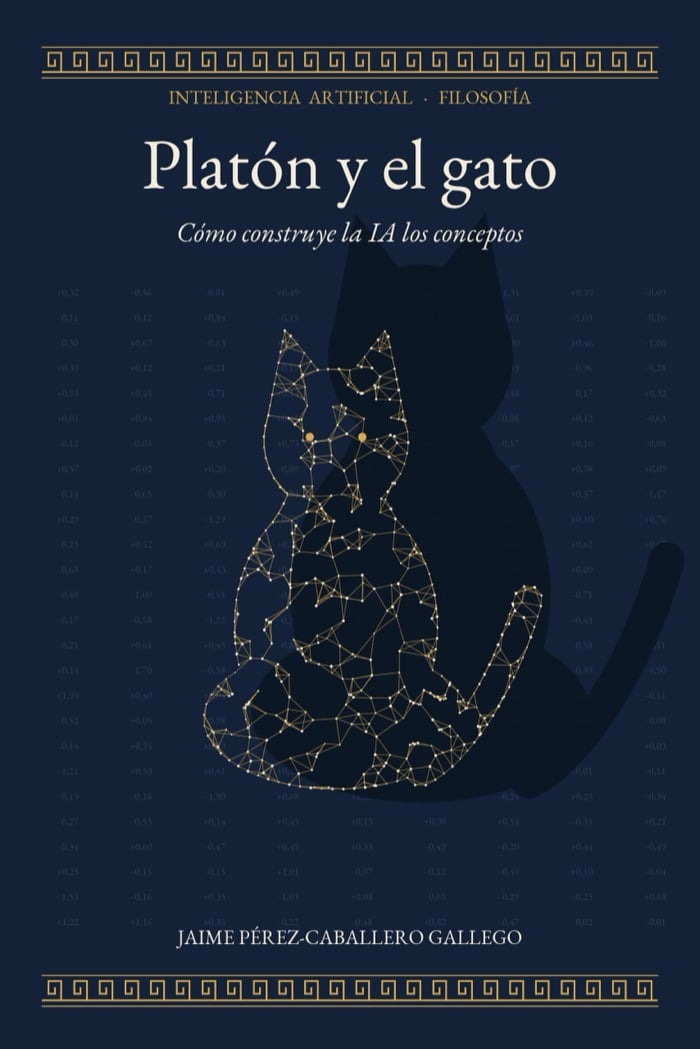
Platón y el gato
Cómo construye la IA los conceptos
Translated title: Plato and the Cat. How AI Builds Concepts
Jaime Pérez-Caballero Gallego
In 2012 a Google network learned to recognize cats without anyone telling it what a cat was. Does the machine know what a cat is, or does it just get it right when it sees one?
This book is in Spanish. The button opens its page on Amazon Spain.
Synopsis
In 2012 a network of Google computers learned to recognize cats without anyone telling it what a cat was. Today machines describe a cat better than many dictionaries. But do they know what a cat is, or do they just get it right when they see one?
This book follows, step by step, how an artificial intelligence builds its concepts: the data, the pieces it cuts text into, the numbers it corrects billions of times, the vectors or embeddings, the company each word keeps, attention, the features nobody taught it. And it reads each step alongside a text by Plato: the cave, the slave boy in the Meno, the Theaetetus, the Sophist, the Cratylus, the Seventh Letter.
The conclusion is simple and demanding. A concept is not defined: it is built, and what is built is a place. The machine has built it better than anyone, but from inside the cave. It does more than get things right, and less than know.
A popular essay, with no formulas and 22 original diagrams, for anyone who wants to understand both what an artificial intelligence really does and what it teaches us about how we think.
What’s inside
Part One · Before the concept
- Prologue. Sixteen thousand processors and a catGoogle’s 2012 experiment and the question of the book.
- 1That is a catPointing is not enough: neither the finger nor the label says what is being named.
- 2Shadows of shadowsThe machine only knows shadows: photos and texts made by others.
- 3The good butcherIt cuts its data into pieces by frequency, not by things.
Part Two · The birth of the concept
- 4Random numbersRandom numbers corrected again and again: the vector is born.
- 5The cat’s featuresThe vector holds the features of the concept, but nameless and in degrees.
- 6The company a word keepsEach word adjusts to its company: a map of meaning is born.
- 7What it is notIt also learns from what something is not: the concept is a place.
Part Three · The concept in use
- 8The weaverThe place changes with each sentence: in Spanish, the gato on the sofa is a cat, the one in the garage is a car jack.
- 9The ladder in a single pointImage and word meet in one point, but the thing itself is missing.
- 10As in a dreamInside there are millions of features the machine does not know it has.
Part Four · What the machine knows
- 11The statues of DaedalusIt speaks by choosing the most probable; its right answers sometimes run away.
- 12The Chinese roomIts space has no anchor in things: a concept without a cat.
- 13The equal itselfIt decides by what is typical in its data, not by what a cat should be.
- 14AI according to PlatoIt does more than get things right and less than know: it has true opinion.
- Epilogue. A cat in the sunBack to the kitchen: the child, the screen and the cat.