Art · Philosophy
Spanish edition
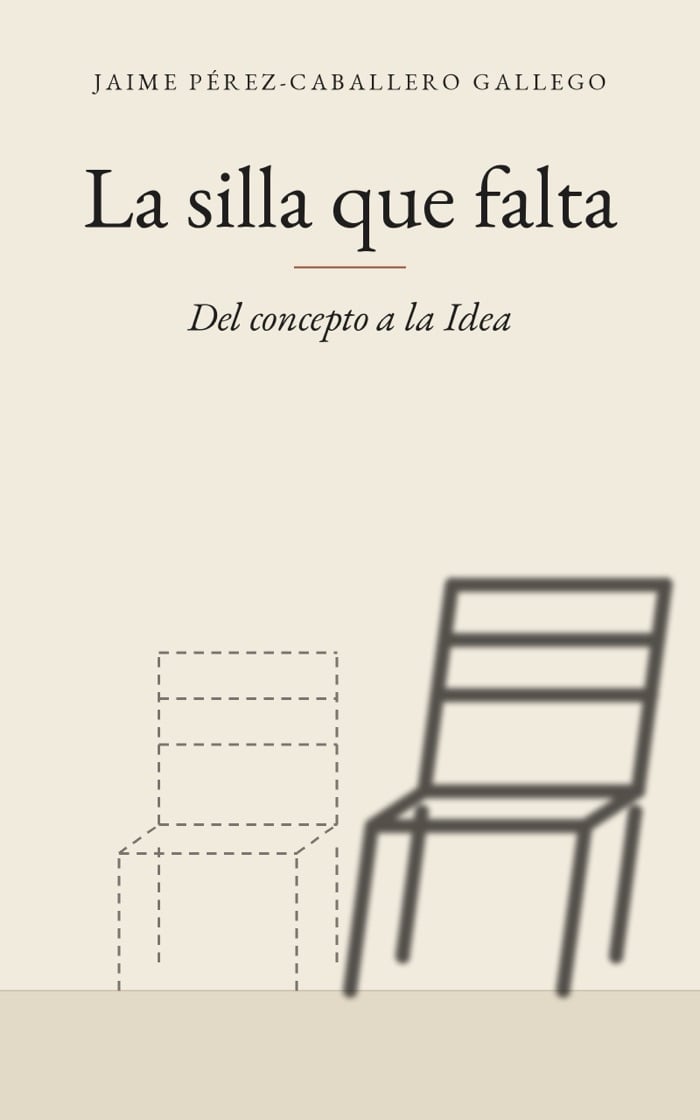
La silla que falta
Del concepto a la Idea
Translated title: The Missing Chair. From Concept to Idea
Jaime Pérez-Caballero Gallego
At MoMA there is a work of art that is a chair: if it breaks, it is replaced and the work stays the same. So what does a chair need to have to be a chair?
This book is in Spanish. The button opens its page on Amazon Spain.
Synopsis
In a gallery at the Museum of Modern Art in New York there is a folding wooden chair. Beside it hangs a life-size photograph of that same chair and, on the other side, the definition of the word chair copied from a dictionary. The work is called One and Three Chairs, and Joseph Kosuth made it in 1965. If the chair breaks, it is replaced with another, and the work remains the same.
So where is the work? Kosuth’s question leads to three more, the questions philosophy began with: what a thing really is, the one we touch, the one we see or the one we think; why something remains the same when everything material about it changes; and what a chair needs to have to be a chair. Twenty-four centuries ago an Athenian gave them an answer we still have not stopped arguing about: the theory of Ideas.
This book follows it from beginning to end, from what came before it, Heraclitus and Parmenides, up to the Idea of the Good, and sets each step beside a moment in the history of art: Monet’s cathedrals, Cubism, Picasso’s first collage, Magritte’s pipe, Warhol’s Brillo boxes.
Its yardstick is the ladder Plato describes in the Seventh Letter: the name, the definition, the image, the concept and the thing itself. The thesis fits in one sentence: a concept is not an Idea. Modern art settled on the first four steps and never managed to hang the fifth. Neither did Kosuth, but he left its gap in plain sight: it is the missing chair.
What’s inside
Part One · Before the Idea
- Prologue. Three chairs at MoMAJoseph Kosuth’s One and Three Chairs and the three questions it leaves open.
- 1What is there?The question philosophy began with, and the painting that had to ask what to paint once photography arrived.
- 2Everything flows. HeraclitusNo one steps into the same river twice: Monet and his cathedrals of Rouen.
- 3What is, is. ParmenidesWhat is does not change: Cubism and the essence of things seen from every side.
Part Two · The Idea
- 4What is piety?Socrates asks what each thing is. Intension and extension.
- 5Heraclitus below, Parmenides aboveThe world of Ideas complete: participation and recollection.
- 6The carpenter, the painter and the dictionaryThe Cratylus, the three beds of the Republic, the Seventh Letter and Picasso’s collage.
- 7Is there an Idea of chair?Plato’s own objections and Aristotle’s answer: form inside matter.
- 8Killing the fatherThe Sophist, what an image is, and Magritte’s pipe.
Part Three · The Idea of the Good
- 9What a chair is forThe good of each thing is to do its job: from Thonet’s café chair to Rietveld.
- 10Beyond beingThe sun, the line and the cave; Monet’s light and Plotinus.
Part Four · Art as Idea
- 11Ockham’s razorThe medieval quarrel over universals.
- 12Art as idea as ideaDuchamp, LeWitt, Weiner and Kosuth: the work becomes the idea.
- 13What art has to be to be artWarhol’s Brillo boxes and Arthur Danto’s answer.
- Epilogue. The missing chairBack in the gallery: the fifth step.