History of religion · Greek philosophy
Spanish edition
El cristianismo antes de Cristo
De Orfeo a Pablo: cómo la filosofía griega sustituyó al profeta de Galilea
Translated title: Christianity before Christ. From Orpheus to Paul: how Greek philosophy replaced the prophet of Galilee
Jaime Pérez-Caballero Gallego
Look in the Creed for a single sentence spoken by Jesus of Nazareth. The immortal soul, the judgment and the Logos were already in Orpheus, Pythagoras and Plato six centuries earlier.
This book is in Spanish. The button opens its page on Amazon Spain.
Synopsis
Every Sunday, in thousands of churches, someone recites the Creed. Look for the sentences in it that came from the mouth of Jesus of Nazareth, one by one, and the result is uncomfortable: practically none. The Trinity, the divinity of the Son, original sin, the soul that survives the body and rises to heaven do not appear in what historians regard, with any confidence, as his words.
What Jesus preached fits on a card: the Kingdom of God is at hand, repent. He was a Jewish, apocalyptic prophet who spoke to Israel, kept the Law and expected God to intervene within the lifetime of those who heard him. What the Church ended up teaching is something else: one God in three persons, a Son who existed before the world, an inherited guilt, a rite of initiation in which one dies and is reborn, a sacred meal and an immortal soul that will be judged.
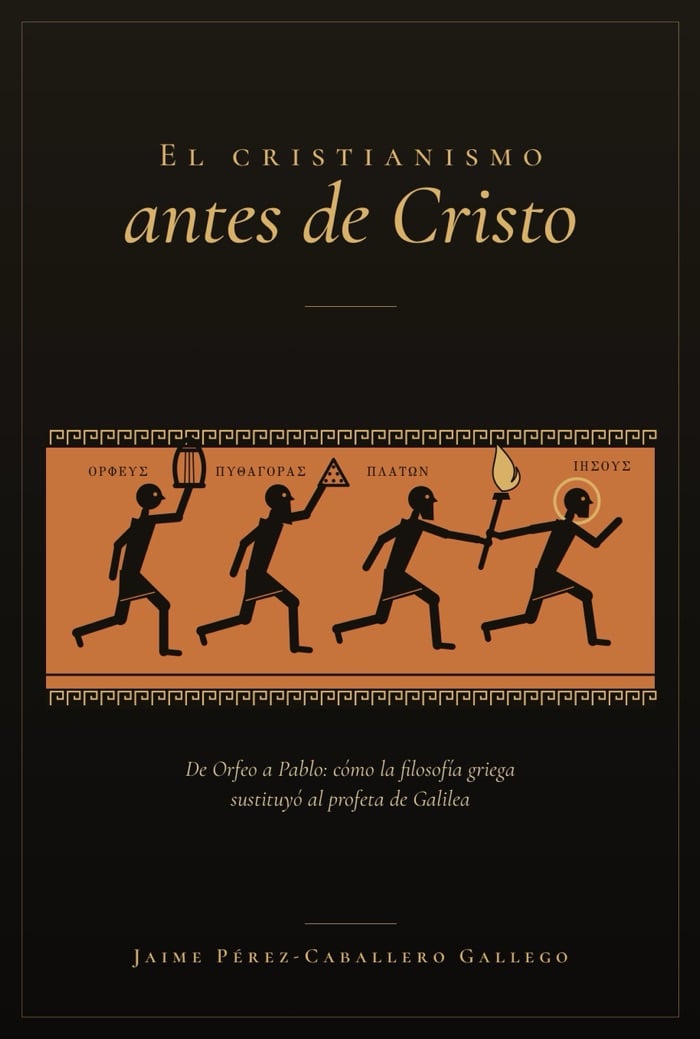
This book shows that almost everything on the second list already existed before Jesus, not in Galilee but in the Greek world. The Orphics had said it six centuries earlier, Pythagoras and his disciples taught it, Plato turned it into philosophy, initiates celebrated it in the mysteries, the Stoics refined it, and Philo of Alexandria, an exact contemporary of Jesus, adapted it to the Bible. There was a Christianity before Christ. It lacked only a name and a hero.
The man who joined the two was Paul, a Jew from Tarsus who thought in Greek and never met Jesus. He translated the story of an executed prophet into the spiritual language of the Greeks and, in translating it, changed it completely. The book distinguishes between Jesusism, what Jesus preached and what his first disciples lived in Jerusalem, and the Christianity born of Paul, and tells how the second replaced the first.
It is not a book against anyone. What it says is known, and taught with more or less caution, by almost every New Testament scholar of the last hundred and fifty years. Here it is told straight through, from Orpheus to Paul, for anyone who wants to understand where the beliefs of so many millions of people come from.
What’s inside
Part One · Christianity before Christ
- Introduction. Two religions with one nameThe Creed experiment, and two words to keep things clear: Jesusism and Christianity.
- 1Orpheus, or the soul that fell from heavenA divine soul locked in the body by an inherited guilt: the first mold of original sin.
- 2Pythagoras, or the community of the savedA way of life with a rule, a novitiate and an examination of conscience, led by a divine master.
- 3Plato, or the theology of the other worldThe body as a prison, the judgment of the soul, heaven, hell and a perfect, unchanging God.
- 4The mysteries, or the art of dying and being rebornA god who dies and returns, an initiation lived as a rebirth, and a sacred meal.
- 5The Logos, or when God became word and musicFrom Heraclitus to Philo of Alexandria: the divine reason that will end up in the first line of John’s Gospel.
Part Two · The prophet
- 6A Judaism between Athens and JerusalemIn Israel there was no immortal soul and no heaven, and the Messiah people awaited was a human king.
- 7Jesus, prophet of the KingdomAn apocalyptic prophet who announces the Kingdom for his own generation, speaks to Israel and keeps the Law.
- 8The Jerusalem church, or Jesusism aliveThose who knew him remained Jews of the Temple and the Law, led by James, his brother.
Part Three · Paul
- 9Saul of Tarsus, a Jew of the diasporaA Jew who thinks in Greek, never met Jesus and receives his gospel in a revelation.
- 10The great translationThe heart of the book: each of Paul’s ideas set beside what Jesus said and what the Greeks were already saying.
- 11Antioch, or the death of JesusismThe clash with Jerusalem, the war by letter and the year 70.
- 12Inventory: what Jesus did not sayThe final count, doctrine by doctrine.
- Epilogue. What remained of the prophetFrom Jefferson’s cut-and-paste Bible to Dostoevsky’s Grand Inquisitor.